
ARMOSA vs RothC: More Insight from the Same Data
If you work in soil carbon, you already know RothC. It has been the industry standard for decades — robust, well-documented, and trusted for tracking long-term soil organic carbon (SOC) trends. Any credible carbon methodology takes it seriously. So do we.
But we kept coming back to one question: if a project is already collecting detailed field data to meet audit requirements, why should that data only answer one number?
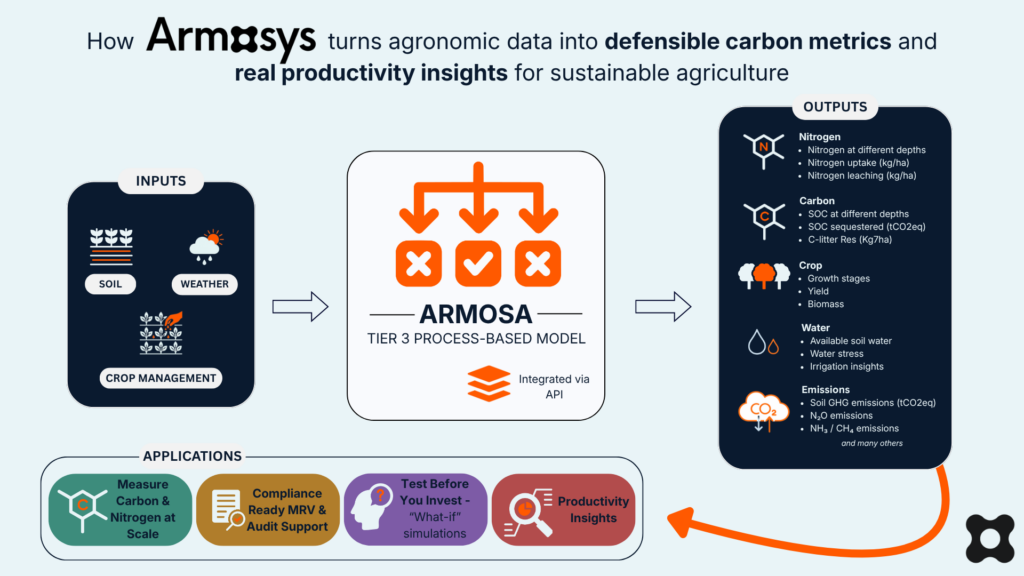
That question is why Armosys is built around ARMOSA, a Tier-3, process-based model developed over 20 years at the University of Milan. Not to replace RothC, but to answer a broader question RothC was never designed to ask.
Two Different Questions
RothC answers: how does soil organic carbon change over time?
ARMOSA answers: how do crops, soil, climate and management interact — and what does that mean for carbon, nitrogen, water and yield, together?
Where RothC estimates carbon inputs from assumptions about residues and manure, ARMOSA simulates the operations behind them directly: crop rotations, sowing and harvest dates, tillage type and depth, fertilization, irrigation, residue handling. Carbon dynamics emerge from actual field management, not simplified proxies.
| Aspect | ARMOSA | RothC |
| Main focus | Crop–soil–climate system: carbon, nitrogen, GHG | SOC turnover only |
| Time step | Daily | Monthly |
| Management detail | High — rotation, tillage, fertilization, irrigation | Low — via simplified C-input factors |
| Outputs | SOC, yield, biomass, N₂O, CO₂, nitrate leaching | SOC pools, CO₂ from SOC |
| Data requirements | Higher | Moderate |
The gap in data requirements is real. What matters is where that extra data comes from.
It Doesn’t Mean More Data Collection
A fair question we hear often: does this mean asking farmers and project teams for more? Not in practice. Robust carbon methodologies already require most of this information — what was planted, when, how the soil was tilled, what and when it was fertilized, whether the crop was irrigated. That’s not new work; it’s audit hygiene most serious projects already do.
ARMOSA simply makes fuller use of data that’s already being collected. Same inputs, more outputs.
Avoiding Carbon Tunnel Vision
It’s easy for a carbon project to narrow into a single metric — track SOC, report SOC, done. But agriculture isn’t a carbon balance. Every tillage pass, fertilizer application and irrigation decision also shapes yield, nitrogen efficiency and long-term soil function. A project that only measures carbon is leaving most of its own data unread.
Because ARMOSA models the full system rather than one pool, the same field data used for a carbon claim can also show what a practice change does to yield stability, nitrogen loss, or water stress — the questions that outlast any single carbon standard.
What This Means in Practice
For project developers and MRV teams: transparency is what gets a number past an auditor. ARMOSA’s process-based structure means every carbon figure can be traced back to the management data behind it — not adjusted after the fact, not held inside a proprietary black box. That’s what lets a number be defended at scale, in front of auditors, investors, and your own board.
For food and agrifood companies: the same dataset that supports a Scope 3 claim can also speak to supply security. Regional calibration matters here — what holds for wheat in France doesn’t hold for olives in Spain or potatoes in Poland. ARMOSA is built to reflect that difference rather than average over it, so the numbers you show your board also hold up as a picture of whether your supply chain stays productive.
The Bigger Picture
RothC remains a sound choice for what it was built to do.
ARMOSA was built to do more with the data projects are already collecting — carbon accounting alongside the agronomic picture that determines whether a program actually works, for the climate and for the people managing the land.
One data stream. A fuller picture of what it’s already telling you.
Join the conversation on LinkedIn