
From Agronomic Modelling to Better Decisions
Agricultural sustainability is not only about measuring what has already happened. It is also about understanding how the decisions made today could affect productivity, soil health and environmental performance over time.
What happens if irrigation is reduced? How could a change in tillage affect soil organic carbon? What difference could a cover crop make? And how might different fertilization strategies affect yield, nitrogen losses and N₂O emissions?
These questions are difficult to answer because agricultural systems are interconnected. Weather, soil, crops and management practices all influence one another.
This is where agronomic modelling can help. A process-based model such as ARMOSA can simulate these interactions and compare different management scenarios before they are implemented. Instead of looking only at past performance, organizations can explore a more useful question:
What could happen if we manage the system differently?
ARMOSA can simulate indicators including crop yield and biomass, soil organic carbon (SOC), N₂O emissions, nitrate leaching and water use. Together, these outputs provide a way to assess both the environmental and productivity implications of different management choices.
We explored the scientific foundations of ARMOSA and agronomic modelling in our previous article. Here, we focus on what those models can help organizations decide.
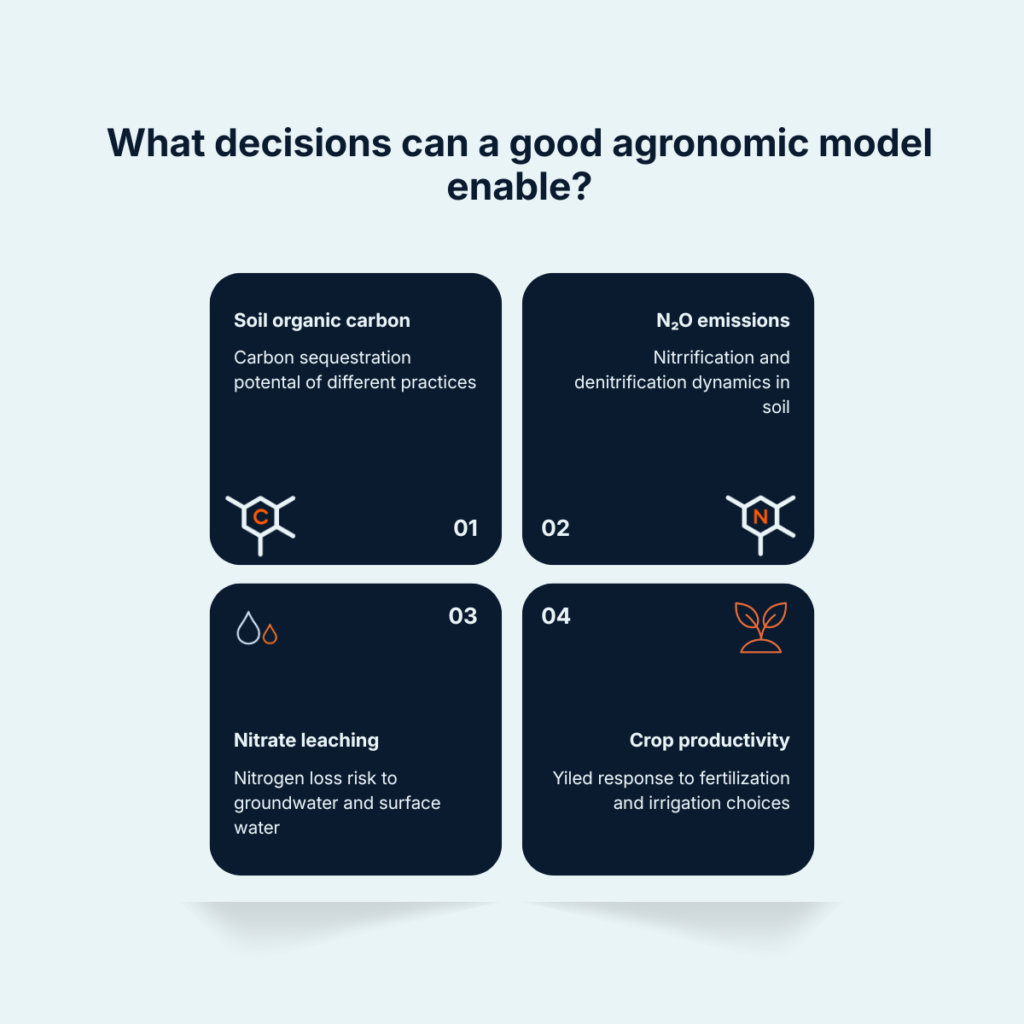
Soil organic carbon
Soil organic carbon is an important indicator of soil health and the long-term sustainability of agricultural systems.
ARMOSA can simulate how SOC changes over time under different management practices. This makes it possible to compare scenarios such as introducing cover crops, reducing tillage, applying organic amendments or changing crop rotations.
Rather than simply asking whether a practice could increase soil carbon, modelling helps address more specific questions: How much could SOC change? Over what period? And how do alternative management strategies compare?
These simulations can provide an initial estimate of the carbon sequestration potential associated with different practices. This can support the design and assessment of carbon farming initiatives and voluntary carbon market projects.
But carbon is only part of the picture.
SOC scenarios can also help organizations assess how management choices may influence soil quality and long-term agricultural performance. This information can support investment decisions, sustainability strategies, ESG reporting and the assessment of targets established by supply chains, certification schemes or policy frameworks. The result is not simply another carbon number. It is information that can help organizations understand the longer-term consequences of different management decisions.
N₂O emissions
Nitrous oxide (N₂O) is an important source of greenhouse gas emissions from agriculture. Understanding when and why these emissions occur is therefore essential when evaluating fertilization and other management strategies.
ARMOSA represents the processes that govern nitrogen dynamics in the soil, including nitrification and denitrification, two of the main processes responsible for N₂O production. The model considers how much nitrogen is applied, when it is applied and its composition, including nitrate (NO₃⁻) and ammonium (NH₄⁺). It then combines this information with soil characteristics and weather conditions such as temperature and precipitation.
This matters because emissions are dynamic.
For example, rainfall following fertilization can create conditions that lead to an N₂O emission peak. A process-based model can represent these interactions rather than relying only on a fixed emission factor. Different scenarios can therefore be compared: lower fertilizer rates, different application dates, alternative fertilizer types, changes in irrigation, tillage, residue management or crop rotations.
For organizations, the practical question becomes: Which strategy can reduce N₂O emissions while maintaining crop productivity and improving nitrogen-use efficiency?
The resulting information can support farm-level emissions assessments, climate-footprint calculations and the evaluation of mitigation strategies.
Nitrate leaching
Nitrogen that is not taken up by crops does not simply disappear. Under certain conditions, nitrate can move through the soil profile and reach groundwater, reducing nitrogen-use efficiency and creating environmental risks.
ARMOSA simulates this process dynamically.
The model represents mineralization, immobilization, nitrification, crop nitrogen uptake and nitrate movement through the soil. Nitrate leaching is therefore calculated through the interaction between nitrogen dynamics and water movement rather than through a predetermined coefficient.
This allows the model to account for factors such as fertilizer rate and timing, nitrogen form, soil properties, weather, water availability, root development and crop nitrogen demand. Organizations can then compare management scenarios such as changing fertilizer rates or application timing, introducing cover crops, modifying crop rotations or adjusting irrigation.
The objective is not simply to estimate nitrate losses. It is to identify which management choices could improve nitrogen-use efficiency while reducing the risk of losses to groundwater.
These insights can support fertilization planning, water-protection strategies and the assessment of environmental performance against regulatory or sustainability objectives.
Crop productivity
Environmental performance is only one side of sustainable agriculture. Management changes also need to make agronomic and economic sense.
ARMOSA can simulate how crop productivity responds to different combinations of weather, soil conditions and management practices.
Take nitrogen fertilization.
Different nitrogen rates can be simulated and compared against expected crop yields. This can help identify the amount of fertilizer needed to reach a production target without applying nitrogen that provides little additional yield but increases costs and environmental losses.
The same principle applies to fertilizer timing and application strategy. By comparing different numbers of applications, application dates and rate distributions throughout the crop cycle, modelling can help identify strategies that improve nitrogen-use efficiency while maintaining productivity. For irrigated crops, ARMOSA can also compare different water-management strategies.
By simulating soil water balance and crop water requirements, different irrigation volumes, frequencies and timings can be assessed against crop performance. This helps identify the trade-offs between water use and yield and evaluate strategies that could improve water-use efficiency.
Bringing these outputs together allows organizations to examine a broader question: How can we use inputs more efficiently without compromising productivity?
That is where agronomic modelling moves from environmental accounting to decision support.
One model, multiple decisions
The value of agronomic modelling is not any single output.
SOC, N₂O emissions, nitrate leaching, water use and crop productivity describe different parts of the same agricultural system. Looking at them together makes it possible to understand trade-offs that would otherwise be difficult to see.
A fertilization strategy might increase yield but also increase nitrate losses. Reduced irrigation might save water but affect productivity. A cover crop might influence carbon, nitrogen and water dynamics simultaneously. ARMOSA provides a way to explore these interactions before decisions are implemented at scale.
For Armosys, this is the practical value of process-based agronomic modelling: turning agronomic data into information that organizations can use to compare scenarios, understand trade-offs and make better-informed decisions.
Join the conversation on LinkedIn