
From Model Performance to Model Applicability: What Verra VMD0053 v3.0 Means for Armosys
The credibility of soil carbon credits depends heavily on the scientific reliability of the models used to quantify them.
As the voluntary carbon market matures, it is no longer enough to say that “the model performs well”. The project needs to understand where the model has been validated, by whom (developers, validators and standard-setters), using which data, for which agricultural practices and crops, and with what level of uncertainty.
The proposed revisions to the Verra VM0042 and VMD0053 v3.0 clearly move in this direction, with stronger standardization of model calibration, validation, uncertainty assessment and documentation.
One of the most important changes is the stronger focus on the model applicability domain.
Model validation needs to reflect the actual conditions where the model will be applied. This means looking at the relevant combinations of Practice Categories and Crop Functional Groups (PC × CFG), together with the environmental conditions represented by the project, rather than relying only on one overall model performance statistic.
This is also central to the way we are developing at Armosys.
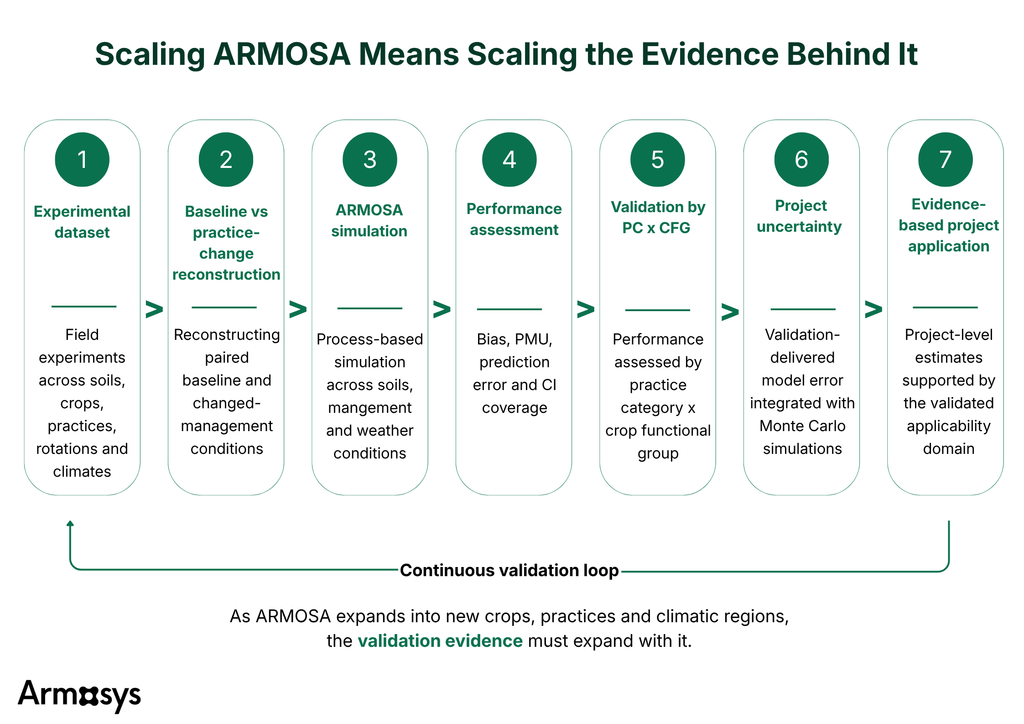
Our validation framework evaluates the ARMOSA model across different agricultural practices, crop functional groups and climatic conditions. The objective is not only to understand how well the model performs overall, but to identify where the available validation evidence is strong and where additional data are still needed.
The same applies to the validation dataset itself.
For the ARMOSA model, we reconstruct experimental comparisons between baseline and practice-change scenarios, including crop rotations, tillage, fertilization, organic amendments, residue management, soils and weather conditions.
This allows us to test whether the model can reproduce the effect of a management change, rather than simply reproduce absolute SOC values.
Model performance is then assessed using several complementary indicators, including bias, pooled measurement uncertainty, prediction error and confidence interval coverage, separately for the relevant PC × CFG combinations.
Uncertainty is also integrated into the modelling workflow. At Armosys, validation-derived model error is combined with Monte Carlo simulations to better represent uncertainty at project level.
This is where we see the broader direction of the methodology revisions becoming particularly important. A process-based model can be computationally scalable, but model scalability also needs evidence of scalability.
When Armosys expands into new crops, practices or climatic regions, the validation domain needs to expand as well.
This is why we see model validation as an ongoing process rather than a one-time compliance exercise.
We continuously work on expanding validation datasets, improving uncertainty assessment, strengthening QA/QC, maintaining model-version traceability and adapting the framework as VM0042 and VMD0053 evolve.
For us, the goal is not simply to generate more simulations.
It is to be able to demonstrate what ARMOSA can simulate, where its predictions are supported by evidence, how uncertainty is quantified, and where further validation or model development is still required.
That is the foundation for making process-based agricultural MRV both scalable and scientifically defensible.
Join the conversation on LinkedIn